


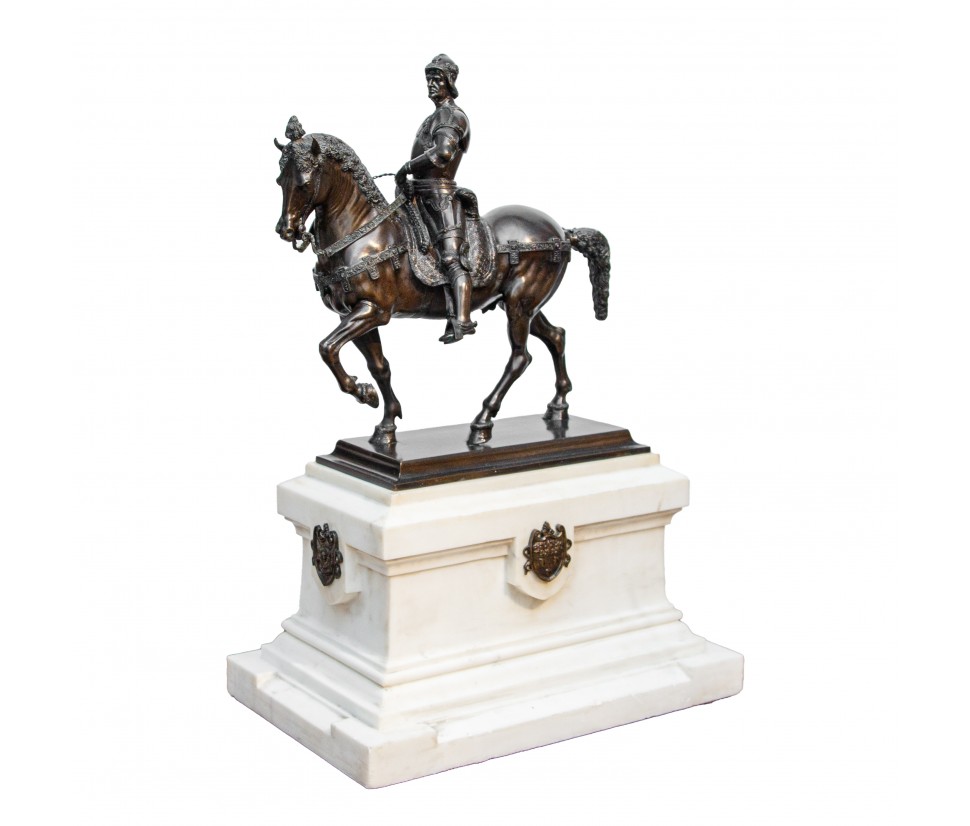
Bartolomeo Colleoni on horseback
Bronze and marble base, cm 63 x 41 x 27
19th century
Bartolomeo Colleoni on horseback
Bronze and marble base, cm 63 x 41 x 27
19th century
19th century
Bartolomeo Colleoni on horseback
Bronze and marble base, cm 63 x 41 x 27
The work under examination is a reproduction of the famous equestrian monument executed by Andrea del Verrocchio for the Campo San Zanipolo in Venice between 1480 and 1488. It depicts the condottiero Bartolomeo Colleoni (1395/1400-1475), one of the most enterprising captains of fortune of the Republic of Venice of the fifteenth century, nicknamed by his mercenary soldiers "invincible", impersonating the classic bold and bold leader, full of charm and pride. The theme of the equestrian statue is particularly widespread in Western sculpture since Greek art. From the Roman Empire this subject assumed a heroic but also propagandistic function that characterized it until the twentieth century. More or less famous condottieri were portrayed in this capacity; famous are the examples of Marcus Aurelius, Napoleon and Garibaldi, there are many works of this kind that adorn the main Italian and foreign squares.
The creation of an equestrian monument, by one of the greatest artists of the fifteenth century, for the leader Bartolomeo Colleoni, who died a few years before, was decreed by the Republic of Venice in 1479. The following year the execution was entrusted to the Florentine Andrea Verrocchio (Florence, 1437 - Venice, 1488). Started in the city of Florence, limited to the wax model, the monument took its final form thanks to Alessandro Leopardi, whom the Serenissima delegated to wait for the work completely in bronze, having meanwhile died Verrocchio. Lorenzo di Credi, executive heir of the master, was outclassed for parochial reasons. The monument, commemorative, was completed by 1488; the remains of the leader were instead placed in the mausoleum that Amadeo executed for Colleoni in the homonymous chapel next to the church of Santa Maria Maggiore in Bergamo. For the realization of the group Verrocchio was inspired by the equestrian statue of Gattamelata Donatello made between 1446 and 1453 for the Piazza del Santo in Padua, the ancient statue of Marcus Aurelius, the horses of Saint Mark and the Regisole of Pavia, also bearing in mind paintings such as the fresco by Paolo Uccello in Santa Maria Novella representing Giovanni Acuto. Verrocchio’s work is the first bronze equestrian statue to portray one of the horse’s legs in a raised position, thus emphasizing the majestic gait of the animal.
Of remarkable quality appears the fusion of this model of classical memory and as well as faithful historical reconstruction, as typical of the spirit of the nineteenth century. Very detailed, down to the smallest details, is the chiseling of the bronze: the armour of the leader, the helmet, the bridles, the mane, the tail, the vestments of the horse, all designed to give immediacy and vibrant brightness to the sculpture. The sources say that the first funeral tolls celebrating the deeds of Colleoni, followed vigorous cannon exploded in Pontoglio, Brescia, Verona and Vicenza, and the bell tower of San Marco sounded in mourning. The strong charisma of the leader shines through sculpturally in the proud prowess of these, solidly erect on the back of the horse, in turn nobly dressed to exalt the rider’s martial and strategic virtues.
A descendant of the Guidotto and the Medolago, Colleoni was born in the castle of Solza, in the province of Bergamo, in 1400. Following the Viscount’s conquest of the castle of Trezzo, already a family possession, Bartholomew had to face the transitory crisis by seeking favor from nowhere and with his weapons. Thanks to his practice at the Kingdom of Naples with Queen Giovanna, Colleoni was finally placed at the service of the Ambrosian Republic on the advice of Sforza himself, defeating the French at Bosco Marengo. He then returned to the service of the Serenissima, residing in the castle of Malpaga, located in the province of Bergamo. He also founded two convents in Martinengo, one male and one female, to fulfill a vow made by his wife Tisbe on her deathbed.
Of great interest are also the four bronze coats of arms on the marble base: you can, in fact, recognize that of the Colleoni family itself, that of the fief of Malpaga (granted by the Venetians to the Colleoni) and that of the marriage of the leader with Tisbe Martinengo, marked by lilies and hearts.
With Ars Antiqua you can defer all amounts up to a maximum of € 7,500 at ZERO RATE, for a total of 15 INSTALLMENTS.
Ex. Tot. € 4,500 = Monthly installment € 300 for 15 months.
Ex. Tot. € 3,600 = Monthly installment € 720 for 5 months.
For amounts over €7,500 or for a longer grace period (over 15 installments), we can provide a custom payment.
Contact us directly to get the best quote.
LIVE TV
- SUNDAY 17.00 - 21.00 Dig.terr. 126 + 809 SKY
- THURSDAY 21.00 - 23.00 Dig.terr. 134 + 809 SKY
- Streaming on our website www.arsantiquasrl.com and on our social networks Facebook and Youtube
All the works proposed by Ars Antiqua are sold accompanied by a certificate of authenticity in accordance with the law and accurate fact sheet.
You can see the works directly at the showroom gallery in Milan, in via Pisacane 55 and 57.
We personally organize transport and deliveries of the works, both for Italy and abroad.
