


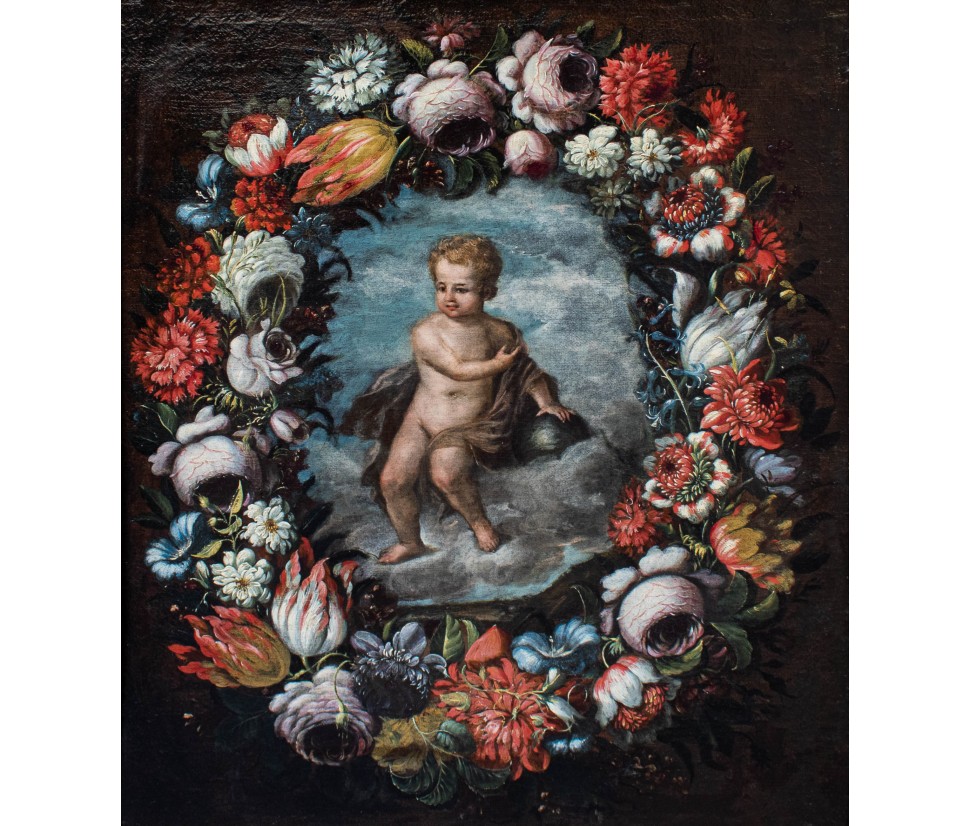
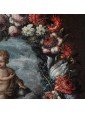
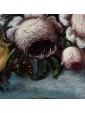
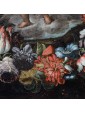

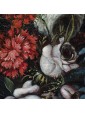
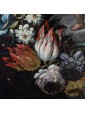
Christ child with globe within garland of flowers
Oil on canvas, 72 x 61 cm
With frame 90, 5 x 80
Lombard School, 17th century
Christ child with globe within garland of flowers
Oil on canvas, 72 x 61 cm
With frame 90, 5 x 80
Lombard School, 17th century
Lombard School, 17th century
Christ child with globe within garland of flowers
Oil on canvas, 72 x 61 cm
With frame 90, 5 x 80
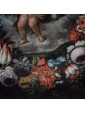
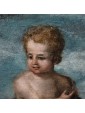
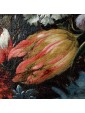
This painting, framed by a sumptuous ancient frame, depicts the figure of Christ the Child with the globe within a floral garland.
The Italian evolution of the pictorial genre of the garland of fiori, a devotional typology born from the intellectual collaboration between Cardinal Federico Borromeo and Jan Brueghel the Elder. From the second half of the sixteenth century Lombard art was affected by a progressive fusion of models fiamminghi mainly ascribable to two factors: the intensity of the economic and commercial relations between Milan and Brussels connected to the common Spanish domination and, subsequently, the passion for art by Cardinal Federico Borromeo
The coexistence of these elements, led to the early seventeenth century to the fusion in the local artistic landscape genres and still life, as well as the creation of a new iconografia: the Madonna and Child in garland of fiori. The genre of garland was then widespread in the seventeenth and first half of the eighteenth century not only in the Lombard area but also in Flanders and Spain.
The analysis of the pictorial evolution of the garland of fiori is a fairly recent field of study that is based on an enlightening article by David Freedberg, published in 1981. For Freedberg adorning a sacred image with a garland has not only a mere decorative function but elevates the object from its earthly nature, emphasizing the importance of its supernatural and devotional function.
Pamela M. Jones states that Borromeo owes the idea of the reason to the adherence to the theological current called, Christian Optimism, according to which nature, and therefore also the fiori, are one of the manifestations of the divine greatness. In addition, we must also look at the habit of adorning religious images with crowns of fiori during the processions, in the diffusione in northern Europe of the so-called Besloten Hofjes, that is multidimensional compositions in which a statue of the Virgin with the Child was decorated by fiori, trees and plants created in silk. In essence, the garland seems to incorporate popular, theological and scIentifici aspects of the society of fine Cinquecento, combining several factors that together contributed to its commercial success in the seventeenth century. The first idea of Madonna with child in the middle of a floral garland is that of the Ambrosian, attributed to Jan Brueghel with figure by Hendrick van Balen
Particular attention is given to the production of garlands by Carlo Antonio Procaccini, member of one of the most important families of artists of the time, who, in the last part of his thirty-year career, specialized in a curious variant of the genre in which the Virgin and Child are replaced by a landscape to fiamminga and New Testament episodes. This typically local declination constitutes a point of contact between Borromeo’s invention and the Nordic development of Lombard art. From here the Lombard painters reworked the motif of the wreath adding inside scenes of the gospels, landscapes and as in our case, the figure of Christ Salvator Mundi.
With Ars Antiqua you can defer all amounts up to a maximum of € 7,500 at ZERO RATE, for a total of 15 INSTALLMENTS.
Ex. Tot. € 4,500 = Monthly installment € 300 for 15 months.
Ex. Tot. € 3,600 = Monthly installment € 720 for 5 months.
For amounts over €7,500 or for a longer grace period (over 15 installments), we can provide a custom payment.
Contact us directly to get the best quote.
LIVE TV
- SUNDAY 17.00 - 21.00 Dig.terr. 126 + 809 SKY
- Streaming on our website www.arsantiquasrl.com and on our social networks Facebook and Youtube
All the works proposed by Ars Antiqua are sold accompanied by a certificate of authenticity in accordance with the law and accurate fact sheet.
You can see the works directly at the showroom gallery in Milan, in via Pisacane 55 and 57.
We personally organize transport and deliveries of the works, both for Italy and abroad.
