


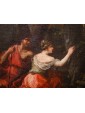
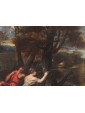
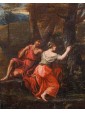
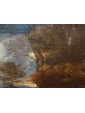
Angelica and Medoro
Oil on canvas, 65 x 48.5 cm
Roman School, 17th century
Angelica and Medoro
Oil on canvas, 65 x 48.5 cm
Roman School, 17th century
Roman School, 17th century
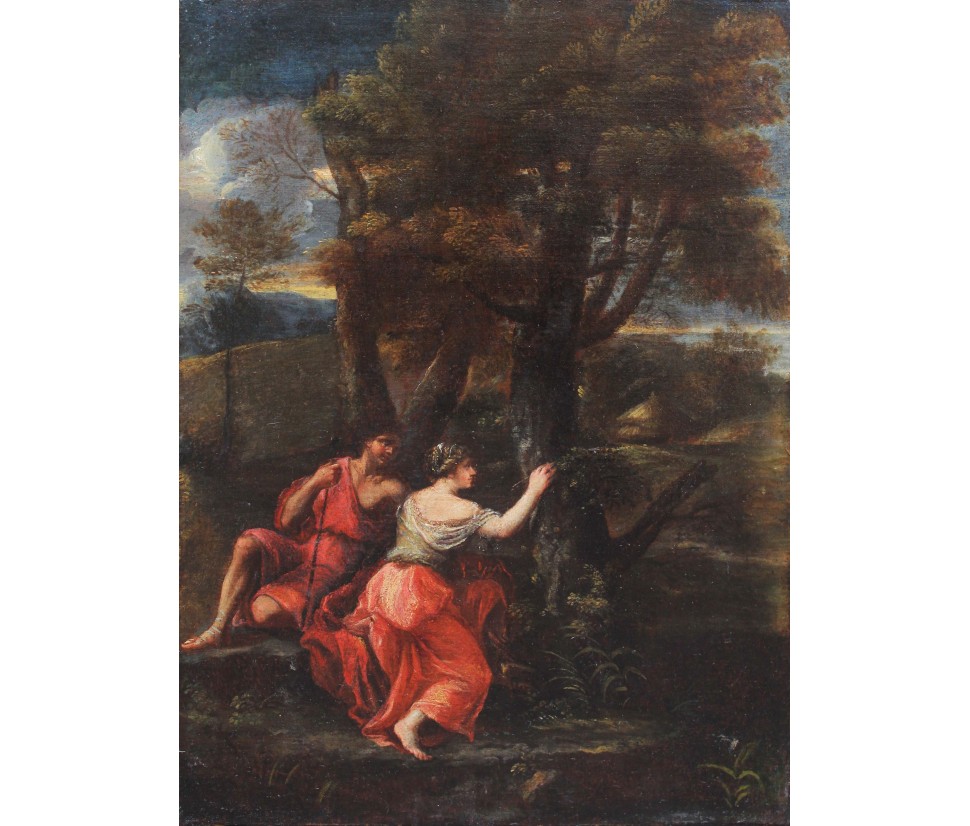
Angelica and Medoro engrave their names on the bark of a tree
Oil on canvas, 65 x 48.5 cm
"Among so many pleasures, everywhere a straight arbor / He saw shading or pure source or rivo, /V'avea spike or coltel immediately dense; /So, if there was any stone men hard:/ And it was out in a thousand places written,/And so in the house in other places the wall, /Angelica and Medoro, in various ways /Tied together of different nodes".
(Ariosto, Orlando Furioso, XIX, 36)
The canvas depicts one of the most famous episodes of Orlando furioso, a chivalrous poem by Ludovico Ariosto, published in Ferrara in 1519 and a source of inspiration for many artists of the following centuries. The protagonist of the nineteenth song is the beautiful Angelica, princess of Catai, of which many Christian paladins have fallen in love, including the valiant Orlando, who in the course of the poem, also meets madness, not seeing their feelings reciprocated. Yet, the charming maiden refuses all suitors, until, struck by the arrows of Love, she falls in love with Medoro, a simple Muslim soldier. Angelica, in fact, away from the battlefields, finds him wounded in the woods and stops to treat him; the more the physical wound heals, the more the wound in the heart grows. Therefore Angelica decides to get married with the Saracen in great secrecy in the forest and, overwhelmed by the love passion, the two engrave their names everywhere, before leaving permanently for India. It is precisely this universal declaration of love, which the painter of the seventeenth century intended to depict. At the edge of the forest, Angelica is intent on carving the bark of a tree, while next to her, softly stretched, is Medoro, who observes absorbed the gesture of the companion.
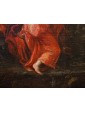
They wear simple clothes, adapted to the bucolic atmosphere in which their love story takes place, far from the bloody war environments narrated in the previous songs by the poet from Ferrara. The painter was to be active in the Roman area in the seventeenth century. In the rendering of nature it seems to look at the ways of Annibale Carracci (Bologna, 1560 - Rome, 1609) and his circle; to the classicism of the time must be traced the graceful poses of the characters, which seem reminiscent of ancient sculptures, and the delicate rendering of the garments, whose colors based on red and white tones, stand out in a landscape otherwise dominated by the soft evening light.
With Ars Antiqua you can defer all amounts up to € 7,500 at ZERO RATE, for a total of 15 INSTALLMENTS.
Ex. Tot. € 4,500 = Monthly installment € 300 for 15 months.
Ex. Tot. € 3,600 = Monthly installment € 720 for 5 months.
For amounts over €7,500 or for a longer grace period (over 15 installments), we can provide a custom payment.
Contact us directly to get the best quote.
LIVE TV
- SUNDAY 17.00 - 21.00 Dig.terr. 126 + 813 SKY
- Streaming on our website www.arsantiquasrl.com and on our social networks Facebook and Youtube
All the works proposed by Ars Antiqua are sold accompanied by a certificate of authenticity in accordance with the law and accurate fact sheet.
You can see the works directly at the showroom gallery in Milan, in via Pisacane 55 and 57.
We personally organize transport and deliveries of the works, both for Italy and abroad.
