


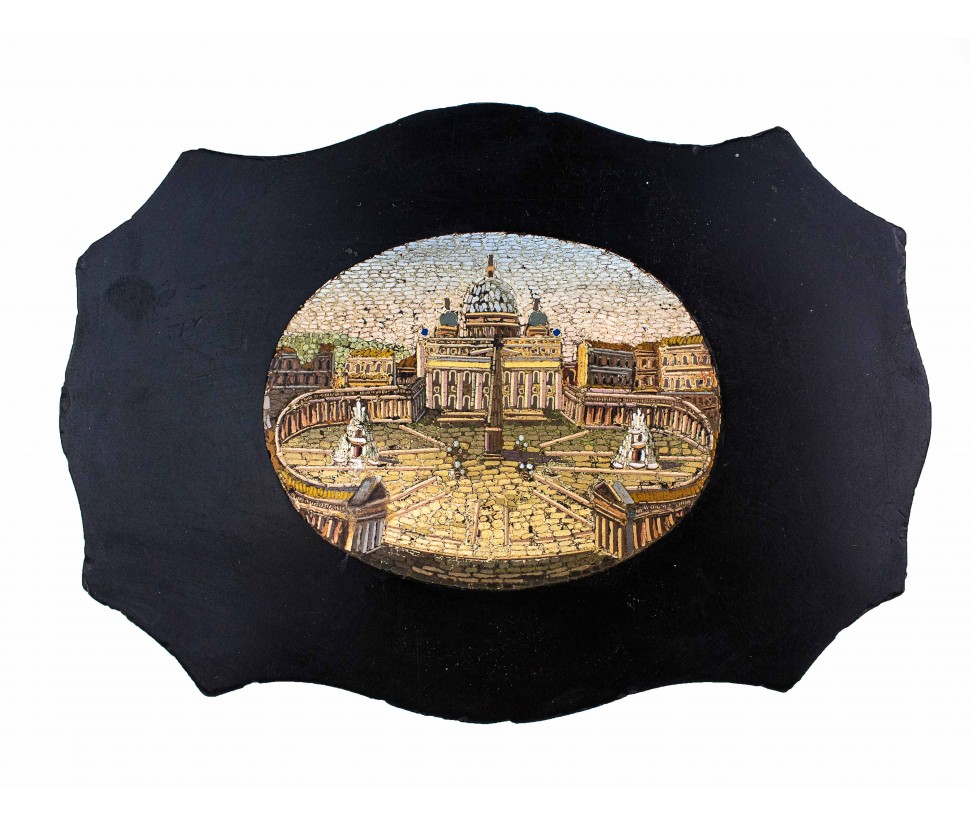
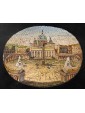
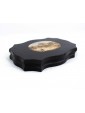
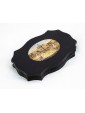
View of St. Peter's Square
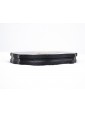
Paperweight in black marble with micromosaic, 14 x 10 cm
Rome, 19th century
View of St. Peter's Square
Paperweight in black marble with micromosaic, 14 x 10 cm
Rome, 19th century
Rome, 19th century
View of St. Peter's Square
Paperweight in black marble with micromosaic, 14 x 10 cm
The micromosaic as an artistic language defined in the technical rules and in the field of invention was born in Rome in the last quarter of the eighteenth century. The city is home to the Vatican mosaic studio established in 1727 and boasts an excellence in the art of mosaics gained with the centuries-old enterprise of decorating the Vatican basilica, started in 1578 and not yet completed. The cultural context favors the study of the ancient both in terms of compositional rules and in terms of figurative contents.
Already at the end of the eighteenth century, Piazza di Spagna and the adjacent streets, favorite places of foreign travelers staying in the city, were filled with private studios where minute mosaics in spun enamels were made and sold. Even the Vatican mosaic studio, traditionally linked to the creation of works of sacred subjects, from 1795 undertook the production of profane subjects, executed with the new technique, to enter the thriving city market.
As for the iconography, it follows the taste of the dominant pictorial culture. In the first production phase he looks to an iconography inspired by the ancient. The discoveries of Herculaneum and Pompeii, especially of the pictorial apparatuses disseminated through the publication of the eight volumes of the Antiquities of Herculaneum on display, published between 1757 and 1792, offer models for the representation of a varied and fantastic repertoire.
Since the early 19th century, micromosaics have flanked classical-mythological themes with an iconography that follows on the one hand the trend of the view of Roman ruins and monuments and, on the other, a series of themes related to the animal and floral world, to sketches of popular life, to the landscape. The themes on which the micromosaic consistently insists are in any case those that depict Rome with its countryside and, in particular, the landscape of Tivoli. The imperial city and the Christian city offer suggestive panoramas, as in the present case. The mass of the Colosseum and the large reservoir of Piazza S. Pietro with the basilica that stands out against the sky are translated into such small dimensions as to fit into the bezel of this paperweight.
The creation of a minute mosaic began with filling the support with mastic and, subsequently, with a layer of plaster. The subject to be composed was drawn in charcoal on the chalk. The execution then took place by removing, one after the other, small portions of plaster and inserting the tiles suitable for reproducing the part of the cut out design in the underlying mastic. The realization time was bound to the hardening which varied with the thickness and with the dimension of the work to be realized (months or years). Once the seasoning was completed, a very delicate wax finishing job was carried out to close the cracks and then the sanding with flint and lead polishing began.
With Ars Antiqua it is possible to defer all amounts up to € 7,500 at ZERO RATE, for a total of 15 INSTALLMENTS.
Ex. Tot. € 4,500 = Monthly installment € 300 for 15 months.
Ex. Tot. € 3.600 = Monthly installment € 720 for 5 months.
For amounts exceeding € 7,500 or for longer periods of time (over 15 installments), we can provide a personalized payment.
Contact us directly to get the best quote.
LIVE
– SUNDAY 17.00 – 21.00 Dig.terr. 126 – Sky 813
– In streaming on our website www.arsantiquasrl.com and on our social networks Facebook and Youtube
