


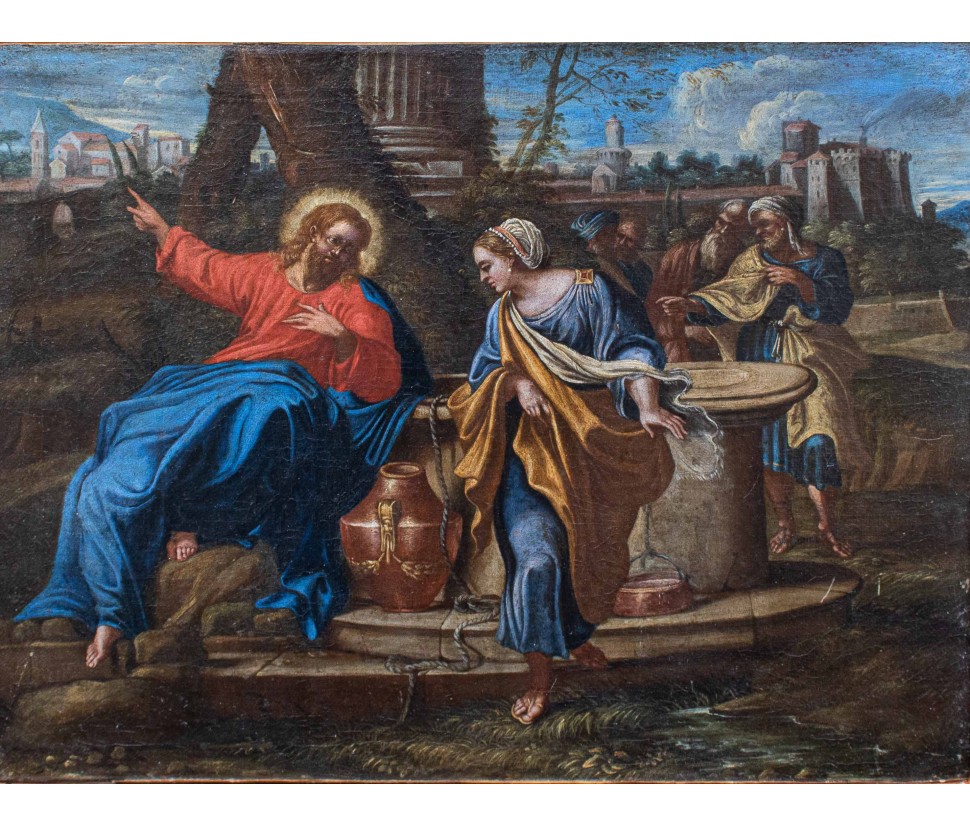
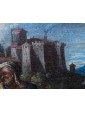
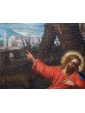
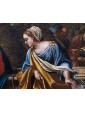
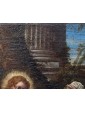
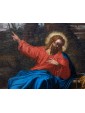
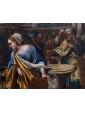
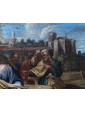
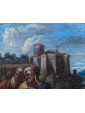
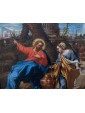
Christ and the Samaritan at the well
Oil on canvas, cm 33 x 43
With frame cm 55 x 64
Emilian School, 17th century
Christ and the Samaritan at the well
Oil on canvas, cm 33 x 43
With frame cm 55 x 64
Emilian School, 17th century
Emilian School, 17th century
Christ and the Samaritan at the well
Oil on canvas, cm 33 x 43
With frame cm 55 x 64
…Whoever drinks of this water shall again thirst; but he who drinks of the water which I will give him, shall never again be thirsty: and the water which I will give him shall become in him a spring of water for eternal life.
John, 4, 13
The canvas examined appears to be the work of an Emilian artist of the mid-seventeenth century, aware of the novelty of the painting of the Carracci. The work takes example from the large canvas, now in Milan at the Pinacoteca di Brera, that Annibale made between 1593 and 1595 for Palazzo Sampieri in Bologna, where the artist worked on a series of frescoes with Ludovico and Agostino Carracci. The same iconographic theme was taken up by Annibale himself in a small autograph replica of the painting, which tends to be identified with that quoted by G.P. Bellori at Oddi’s house in Perugia, now kept in the Szépmuvészeti Mùzeum in Budapest.
The project, carried out jointly by Annibale, Agostino and Ludovico Carracci - and was the last joint effort of the Carracci - included both a cycle of frescoes (with Stories of Hercules) and three large canvases to be used as overheads in as many rooms of the palace. The three paintings made up a unitary cycle, dedicated to evangelical episodes in which Jesus talks with women. In addition to the Samaritan of Hannibal, were part of this triptych ideal the Christ and the Canaanite of Ludovico Carracci and the Christ and the Adulteress of Agostino Carracci.
All three paintings were purchased in 1811, along with many other works from the Sampieri Collection (one of the most significant collections of works by the Scuola emiliana), from the Pinacoteca di Brera, where they are still located.
The Christ and the Samaritan of Brera is placed in that particular moment of painting by Annibale Carracci in which the influence of Venetian painting (which since 1588 about characterized his art) are associated with references to the pictorial tradition of Central Italy and return to the example of Correggio (master that Annibale had followed with great interest in his early years). In the work, in fact, there are references to Veronese, but also a more pronounced attention to classical values, so that Denis Mahon defined the painting as "proto-poussinesque", that is the precursor of the art of Nicolas Poussin, one of the greatest interpreters of seventeenth-century classicism.
La Samaritana braidense is based on a preparatory drawing traditionally attributed to Ludovico Carracci, but last referred to Agostino (British Museum) from which however Annibale differed in several parts.
With San Rocco’s Alms, the Samaritan of Brera is the only painting of the youngest of the Carracci from which an engraving was made while Annibale was still alive. The print is variously attributed to Guido Reni or Francesco Brizio and its first edition dates back to 1595: it was therefore executed shortly after the dismissal of the canvas, as a testimony of the success and resonance that this work enjoyed. The same work under examination is treated by an engraving, given the composition mirror with the prototype carraccesco.
The representation of the Gospel episode follows what has been handed down from the Holy Scriptures, the scene is set in the countryside in the farm that the patriarch Jacob had given to his son Joseph, at the center of which there was a well called "di Giacobbe", used both to draw water and to water the animals.
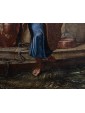
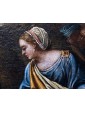
In the work examined we find represented the second part of the gospel story; at the center appear the Samaritan and Jesus. Depicted as a young woman, who initially tried to stand up to Jesus in dialogue, the Samaritan appears here now overcome by the eloquence and revelations of Christ. Jesus, sitting with his hand on his chest alludes to himself as the Messiah, while with the other hand he indicates the city, which is seen in the distance, inviting the woman to spread the news of the meeting. In the background come the Apostles, returning from Sicar with food, according to what is narrated in the Gospel.
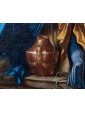
The altar, represented between the Samaritan woman and Jesus Christ, reminds us that their dialogue takes place on the theme of physical and spiritual thirst.
With Ars Antiqua it is possible to extend all amounts up to € 5,000 at ZERO RATE, for a total of 12 INSTALLMENTS.
Ex. Tot. € 4.500 = Monthly instalment € 375 for 12 months.
Ex. Tot. € 3.600 = Monthly instalment € 720 for 5 months.
For amounts over € 5,000 or for a longer delay in time (more than 12 installments), we can provide a personalized payment.
Contact us directly to get the best quote.
LIVE TV
- SUNDAY 17.00 - 21.00 Dig.terr. 126 - Sky 861 - 937
- Streaming on our website www.arsantiquasrl.com and on our social networks Facebook and Youtube
