


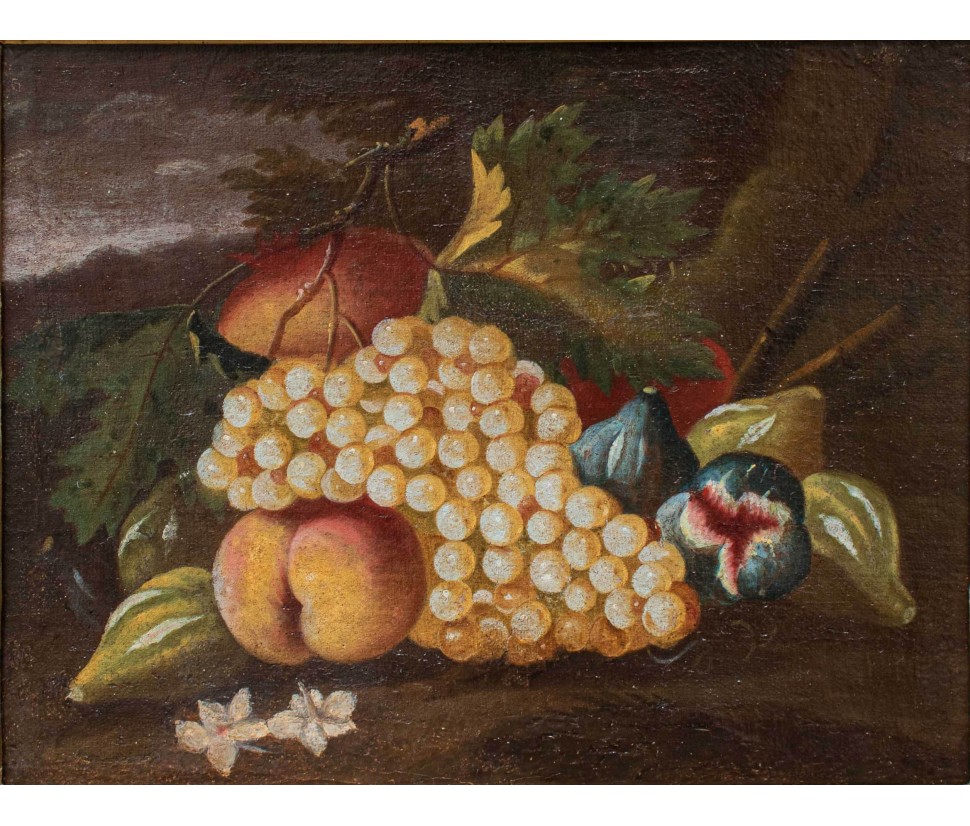
Still life with fruits
Oil on canvas, cm 33.5 x 42
With frame, cm 46,5 x 55,5
Circle of Giovanni Paolo Castelli, known as Spadino (Rome, 1659 - 1730)
Still life with fruits
Oil on canvas, cm 33.5 x 42
With frame, cm 46,5 x 55,5
Circle of Giovanni Paolo Castelli, known as Spadino (Rome, 1659 - 1730)
Circle of Giovanni Paolo Castelli, known as Spadino (Rome, 1659 - 1730)
Still life with fruits
Oil on canvas, cm 33.5 x 42
With frame, cm 46,5 x 55,5
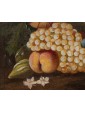
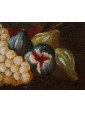
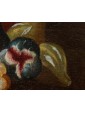
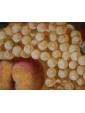
The fruity still life offers turgid autumn firstfruits, generously watered in its ripe fullness. To velvety peaches are sought-after bunches of white grapes, with split figs; behind which you can see a sculptural pomegranate. The particular silkiness that covers the grapes, milky in the gathering of the berries, allows to bring this artist closer to the work of Spadino, a Roman naturamorphic long appreciated.
The archival research has made it possible to distinguish three painters from the Castelli family, specialized in the genre of still life: the two brothers Bartolomeo (called the Old) and Giovanni Paolo (called the Swordsmith) and his son, Bartolomeo the Younger, also nicknamed Swordman. In particular, it was thanks to Federico Zeri in the fifties that we began to specify progressively the core of still life in Collezione Spada in Rome, generically identified as "Spadino", and assigning four to the hand of the young Bartolomeo (remember the Still Life with grapes, apples and figs and Still Life with peaches, 13 x 29.5 cm, Galleria Spada). The very dark variants of the old "Spadavecchio" were a discriminating element in distinguishing the hand of Giovanni Paolo Castelli from that of the family (Ferdinando Bologna, Natura in posa. Aspetti dell'antica natura morta italiana, 1968 and Luigi Salerno, Nuovi studi sulla natura morta italiana e Nature morte di frutta, 1989). Heir to an already elaborated tradition, John Paul reinterprets with a heavy sense of frankness the most genuine simplicity of the fruits portrayed. Opposing the dual temptation of realism and inventive exuberance, Spadino dedicated himself to painting fruits, rather than flowers, animals, pottery, glass or silver, to evoke the luxury of men and the sumptuousness of nature, Making a symptomatic taste for abundance and splendor combined with the sense of precariousness of vegetation.
Formed within the brilliant climate of the naturamorphism of the Capitol, the Spadino never forgot the suggestions arising from the Flemish Abraham Brueghel, who had marked the evolution of the genre in the second century XVII, and not even by the German Christian Berentz, in Italy since 1689. The analysis of natural equipment through sudden turns of color, changing from dark to light lakes, as happens in this case, derived from this particular oltramontana comma, established in the capital and strongly influencing the context.
It is possible to compare the present composition, for the carefully chosen fruits and for the long line arrangement, concretely close in the pieces depicted, with several works made by Spadino and now in private collection. His works are also mentioned today in the collections of the Bardini Museum in Florence, Raccamadoro Ramelli (Fermo), Galleria Spada (Rome).
With Ars Antiqua it is possible to defer all amounts up to € 5,000 at ZERO RATE, for a total of 12 INSTALLMENTS.
Ex. Tot. € 4.500 = monthly instalment € 375 for 12 months.
Ex. Tot. € 3.600 = Monthly payment € 720 for 5 months.
For amounts over €5,000 or for a longer delay in payment (over 12 instalments), we can provide a personalized payment. Contact us directly to get the best quote. Live TV - WEDNESDAY 21.00 - 24.00 Dig.terr. 126 - Sky 861 - 937 - SUNDAY 17.00 - 21.00 Dig.terr. 126 - Sky 861 - 937 - Streaming on our website www.arsantiquasrl.com and on our social networks Facebook and Youtube
